Industrial painting refers to the process of applying a protective or decorative coating layer onto the surface of a product or component. It is widely used in industries such as automotive manufacturing, furniture production, machinery manufacturing, electronics, and metal processing.
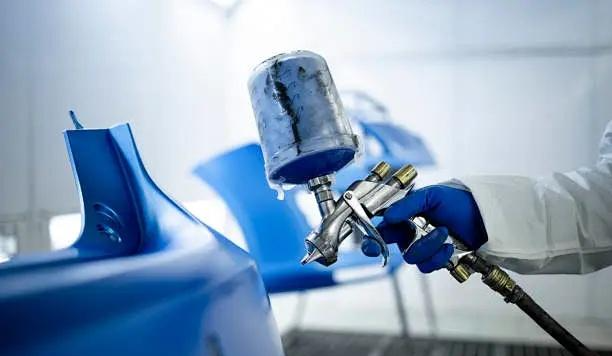
A paint booth or spray painting room is a common working environment where coating materials are applied through spraying processes. However, during painting operations, various hazardous substances can be generated, including:
- Benzene compounds
- Formaldehyde
- Volatile Organic Compounds (VOCs)
- Flammable organic vapors
- Dust particles
Excessive dust concentration may also create explosion risks under certain conditions. Long-term exposure to VOC emissions and toxic substances can seriously affect workers’ health.
Therefore, reliable VOC gas detection has become an important part of industrial safety management, environmental compliance, and worker protection.
Sources of VOC Emissions in Paint Booths
During industrial coating processes, VOCs are mainly released during several stages, including:
- Paint mixing
- Spray coating
- Flow leveling
- Drying and curing
- Equipment cleaning
The major sources include VOC-containing materials such as:
- Paints
- Thinners
- Cleaning solvents
- Hardeners
- Adhesives
- Sealants
These materials release organic vapors during use and evaporation.
Paint shops and printing facilities are considered major VOC emission sources.
During spray painting processes, aromatic hydrocarbons such as:
- Benzene
- Toluene
- Xylene
can evaporate rapidly from coating materials.
During drying and curing processes, high temperatures accelerate the release of:
- Ester solvents (such as ethyl acetate and butyl acetate)
- Ketones (such as acetone and methyl ethyl ketone)
- Other organic compounds
These emissions can create high concentrations of VOC gases inside industrial workshops.
Similarly, printing facilities generate VOC emissions from:
- Ink
- Solvents
- Fountain solutions
- Cleaning agents
Gravure printing and solvent-based ink applications are particularly significant VOC emission sources.
Safety Risks Caused by VOCs in Painting Facilities
1. Explosion Risk from Flammable VOC Vapors
During the drying and curing process, paint ovens and drying tunnels release large amounts of VOC vapors.
When flammable organic vapors accumulate and mix with air at certain concentrations, an explosive atmosphere may form. If ignition sources such as static electricity, sparks, or high-temperature surfaces are present, combustion or explosion accidents may occur.
Continuous VOC gas detection helps identify abnormal gas concentration levels before they reach dangerous conditions.
2. Health Hazards from Toxic VOC Exposure
Many VOC components pose significant health risks.
For example:
- Benzene is classified as a strong carcinogen.
- Toluene and xylene may affect the central nervous system.
- Long-term exposure may damage liver and kidney functions.
Installing VOC monitoring systems in painting environments helps reduce occupational exposure risks and improves workplace safety.
3. Inefficient VOC Treatment Risks
Activated carbon adsorption is one of the most common VOC treatment methods used by small and medium-sized enterprises.
However, practical problems often occur, including:
- Using low-quality activated carbon
- Insufficient filling quantity
- Failure to replace carbon regularly
These issues can significantly reduce treatment efficiency and may cause VOC emissions to exceed acceptable levels.
Real-time VOC monitoring can help evaluate treatment system performance and identify abnormal emissions.
How to Standardize Spray Painting Processes?
To reduce VOC emissions and improve workplace safety, industrial painting processes should follow proper ventilation and exhaust control requirements.
Recommended practices include:
- Using enclosed painting equipment or operating within enclosed areas
- Collecting exhaust gases and directing them into VOC treatment systems
- Installing local exhaust systems when complete enclosure is impossible
- Using dry spray booths for newly built production lines
- Promoting automated painting systems and circulating air technologies
When wet spray booths are used:
- Circulating water pump rooms and slag removal areas should be enclosed
- Exhaust gas should be collected and processed through VOC treatment systems
Painting workshops should also be designed according to proper ventilation standards. Increasing ventilation airflow simply to dilute VOC concentration is not considered an effective emission control method.
How to Monitor VOCs Quickly, Accurately, and Cost-Effectively?
For industrial VOC monitoring, PID gas sensors provide an efficient and practical solution.
Traditional VOC detection methods include:
FID (Flame Ionization Detector)
FID provides high detection accuracy but has several limitations:
- Requires hydrogen gas supply
- Large equipment size
- More complex operation
GC (Gas Chromatography)
GC can provide qualitative and quantitative analysis, but:
- Equipment cost is high
- Response time is relatively slow
- Requires professional operation
Compared with these technologies, PID sensors provide a compact, fast, and economical solution for daily VOC monitoring.
How Does a PID Gas Sensor Work?
A PID gas sensor for VOC detection works based on photoionization technology.
The sensor uses a high-energy ultraviolet (UV) lamp, commonly with photon energy such as 10.6 eV.
When VOC molecules enter the detection chamber:
- UV photons interact with gas molecules.
- If the ionization energy of the gas is lower than the UV photon energy, molecules become ionized.
- Positive ions and free electrons are generated.
- The electrical signal is amplified and converted into a concentration reading.
Because the measurement process does not consume the target gas, PID sensors are considered non-destructive gas detection devices.
Their advantages include:
- Fast response
- High sensitivity
- Low maintenance
- Continuous monitoring capability
- Suitable for portable and fixed VOC detection systems
Therefore, PID technology has become widely used for:
- Daily industrial inspections
- VOC leakage detection
- Environmental monitoring
- Emission control verification
- Paint booth safety monitoring
Recommended PID Sensor for VOC Detection in Paint Booths
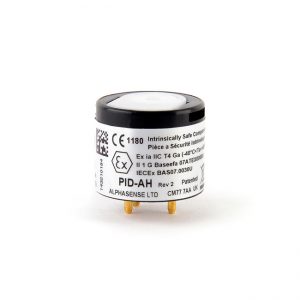
For applications requiring accurate VOC gas detection in paint booths, ISweek recommends the ALPHASENSE PID-AH PID gas sensor.
The PID-AH2 uses advanced photoionization technology and is designed for high-performance VOC monitoring.
Key Features of ALPHASENSE PID-AH:
- High sensitivity with detection resolution down to 1 ppb
- Compact size for easy system integration
- High accuracy and repeatability
- Low power consumption
- Suitable for portable and fixed gas detection equipment
- Explosion-proof compatible design options
The sensor can be integrated into:
- Portable VOC detectors
- Fixed VOC monitoring systems
- Industrial safety equipment
- Paint booth monitoring devices
- Environmental monitoring instruments
With its high sensitivity and fast response capability, the ALPHASENSE PID-AH provides an effective solution for detecting VOC emissions in industrial coating and painting environments.
Conclusion
VOC emissions from paint booths and spray coating processes create challenges related to worker safety, environmental protection, and industrial process control.
Reliable VOC gas detection allows manufacturers to monitor hazardous organic vapors, identify abnormal emissions, and improve workplace safety.
Compared with traditional detection technologies, PID gas sensors for VOC detection provide advantages including fast response, high sensitivity, compact design, and easy integration.
For automotive painting, industrial coating, furniture manufacturing, and other VOC-intensive applications, advanced PID sensors such as the ALPHASENSE PID-AH help companies achieve safer, smarter, and more efficient VOC monitoring.